









Iris
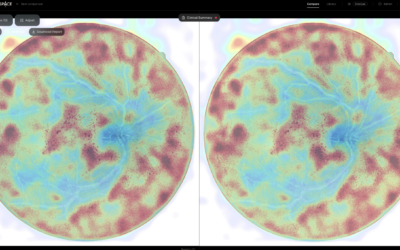
Iris is a visual search AI platform for semantic image search, similarity analysis, anomaly detection, and visual change tracking. It transforms large collections of unstructured images into searchable and explainable visual intelligence.
The Cognitive Engine of Visual Intelligence
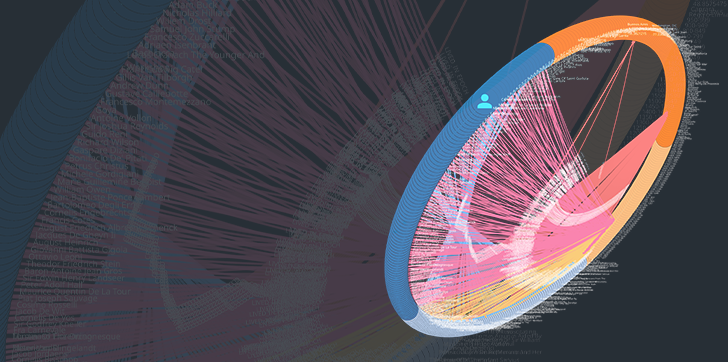
Iris transcends conventional image recognition, decoding meaning, context, and anomalies from raw pixels. It transforms unstructured visuals into structured knowledge, an indispensable foundation for diagnostics, monitoring, advanced analytics, and integration with a data governance platform like Atlas.
Built as a Universal Visual Intelligence Platform, Iris enables AI-powered visual search, empowering semantic search, anomaly detection, and change tracking with precision at scale across large visual datasets. Its architecture enables advanced capabilities such as cross-modal retrieval (text ↔ image), temporal differencing, and explainable overlays, all accessible through powerful APIs and SDKs. Leveraging GPU-accelerated inference and high-performance vector retrieval, it delivers low-latency results even at catalog scale. Hybrid classical quantum kernels push metric learning and hard-negative mining beyond current limits, establishing a new benchmark for cognitive visual intelligence.
How It Works
Ingest & normalize
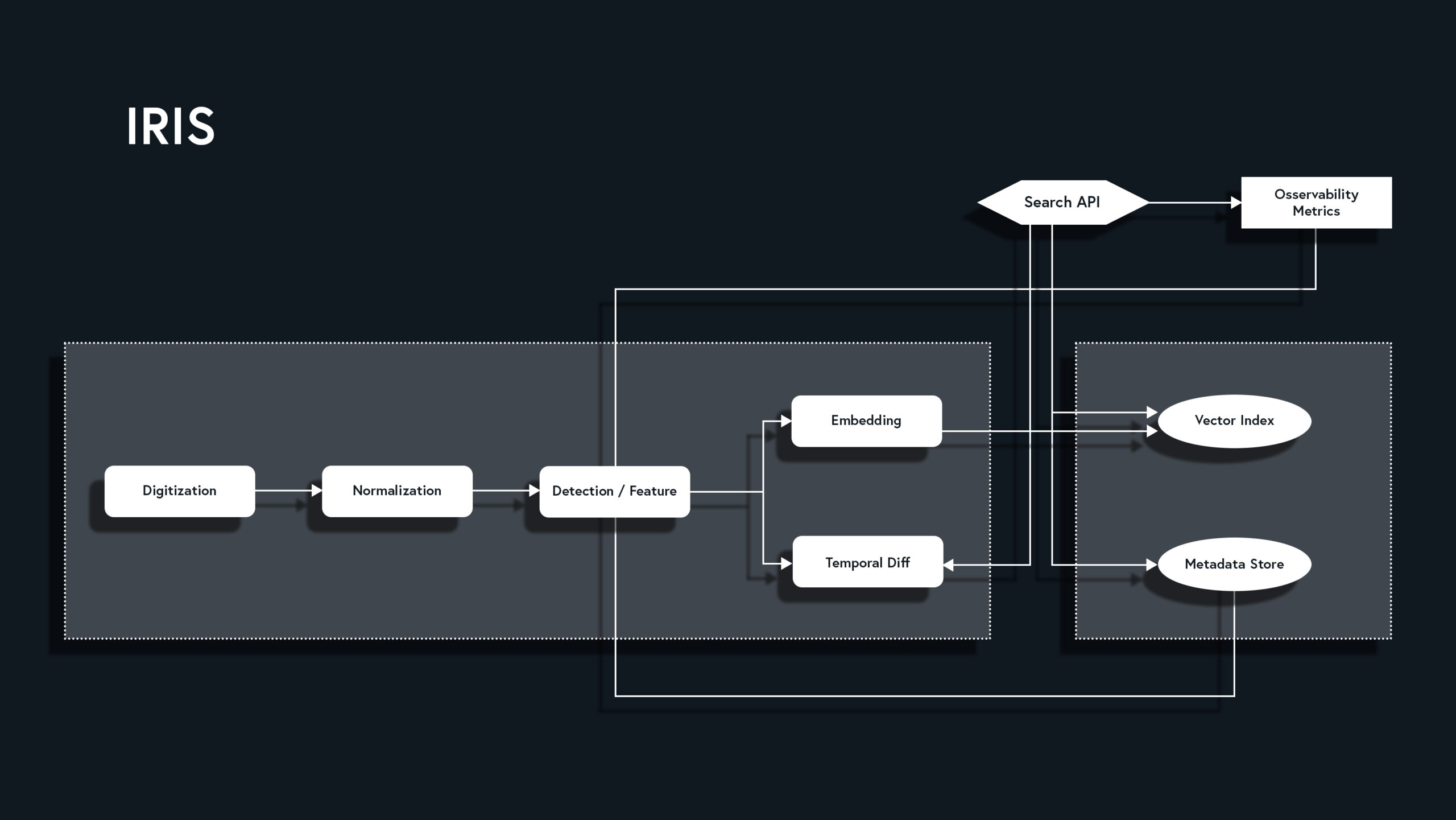
Processes images and video with metadata; unifies color space and resolution; and supports IIIF/DICOM adapters for interoperability.
Perception models
Extracts embeddings, attributes, and anomaly maps; stores vectors in a searchable index and generates evidence-based overlays and rationale summaries.
Query & explain
Delivers text- and image-based search, temporal comparisons (T-1 vs T-0), and pixel-level “why” overlays for transparency and trust.
Key Features
Cross‑modal search
Adaptive retrieval across text ↔ image and image ↔ image with domain-aware profiles, enabling contextual exploration of vast visual datasets.
Temporal differencing and trend lines
Reveals hidden dynamics and evolving patterns by tracking changes over time, supporting anomaly detection and predictive insights.
Explainable overlays
Saliency maps, highlighted regions, and rationale text provide transparent AI interpretation for critical decision-making.
Streaming & Batch Pipelines
Handles real-time streams and batch data with strict multi-tenant isolation, service-level objectives for latency/availability, and observability hooks for enterprise monitoring.
Visual Search AI vs Traditional Image Search
Traditional image search often relies on filenames, metadata, tags, or manually assigned categories. Visual search AI analyzes the image itself, allowing users to find visually or semantically related content even when metadata is incomplete or unavailable.
Iris extends this capability through text-to-image search, image-to-image similarity matching, anomaly detection, temporal comparison, and explainable visual overlays.
Iris Applications
Large-Scale Catalog Retrieval
Iris empowers organizations to navigate vast digital collections with semantic and visual analytics. It enables the detection of exact matches, near-duplicates, and subtle variations across complex datasets, making large-scale retrieval both efficient and reliable. This capability supports digital archives, corporate repositories and any environment where catalog integrity is critical.
Continuous Monitoring and Incident Triage
When integrated into operational pipelines, Iris provides continuous condition monitoring and first-level incident triage. Its ability to identify anomalies in real time shortens response cycles, strengthens resilience, and reduces operational risk across industries ranging from industrial systems to cultural heritage preservation.
Insights detected by Iris can also feed downstream workflows where organizations need to convert visual signals into real-time AI decision-making with Ratio.
Pre-Verification for Authentication Workflows
Iris introduces an automated pre-verification layer within authentication and validation processes. By offering evidence-based analysis before human review, it minimizes the risk of error and enhances the reliability of decision-making in sensitive domains such as digital preservation, provenance analysis, and artwork authenticity.
For workflows that require verifiable provenance and chain-of-custody records after visual pre-verification, Iris can be paired with digital provenance software like Authentica.
Content Quality Assurance and Curation
For editorial, research, and curatorial teams, Iris supports the quality assurance and curation of complex datasets. By combining objective metrics with visual insights, it streamlines selection, review, and organization, ensuring that large volumes of content maintain both accuracy and contextual integrity.
Iris can also complement AI 3D reconstruction with Aego when visual datasets need to be transformed into condition-aware digital twins for inspection, conservation, or immersive applications.
Results of Retrieval and Anomaly Detection
Iris demonstrates robust performance across both retrieval and anomaly detection benchmarks. On large-scale image catalogs, Top-K retrieval consistently achieves high precision and recall, while anomaly detection maintains an exceptionally low false-positive rate even under stringent recall thresholds.
Performance remains well within interactive boundaries: on GPU-accelerated nodes, median inference (p50) typically remains at or below 80 ms per image, with p95 latencies around 250 ms depending on dataset size and complexity. These results confirm the platform’s readiness for real-time, enterprise-scale deployment, where accuracy, transparency, and responsiveness are equally essential.