









Aego

High-Fidelity 3D Reconstruction from 2D Photosets
Aego is photogrammetry digital twin software that transforms ordinary 2D photosets into production-grade 3D digital twins enriched with condition metadata. The output is a compact glTF model carrying condition layers such as surface normals, depth, and defect masks. These are not static replicas but condition-aware 3D assets generated to support simulation, inspection, and long-term monitoring within the QuantumSpace ecosystem. Aego provides the geometric and material counterpart to visual and semantic analytics, bridging empirical evidence with scalable deployment.
AI 3D reconstruction combines computer vision, photogrammetry, and machine learning to transform multiple two-dimensional images into measurable 3D models. Aego extends this process by embedding condition information such as depth, surface normals, and defect data directly into the reconstructed asset.
How It Works
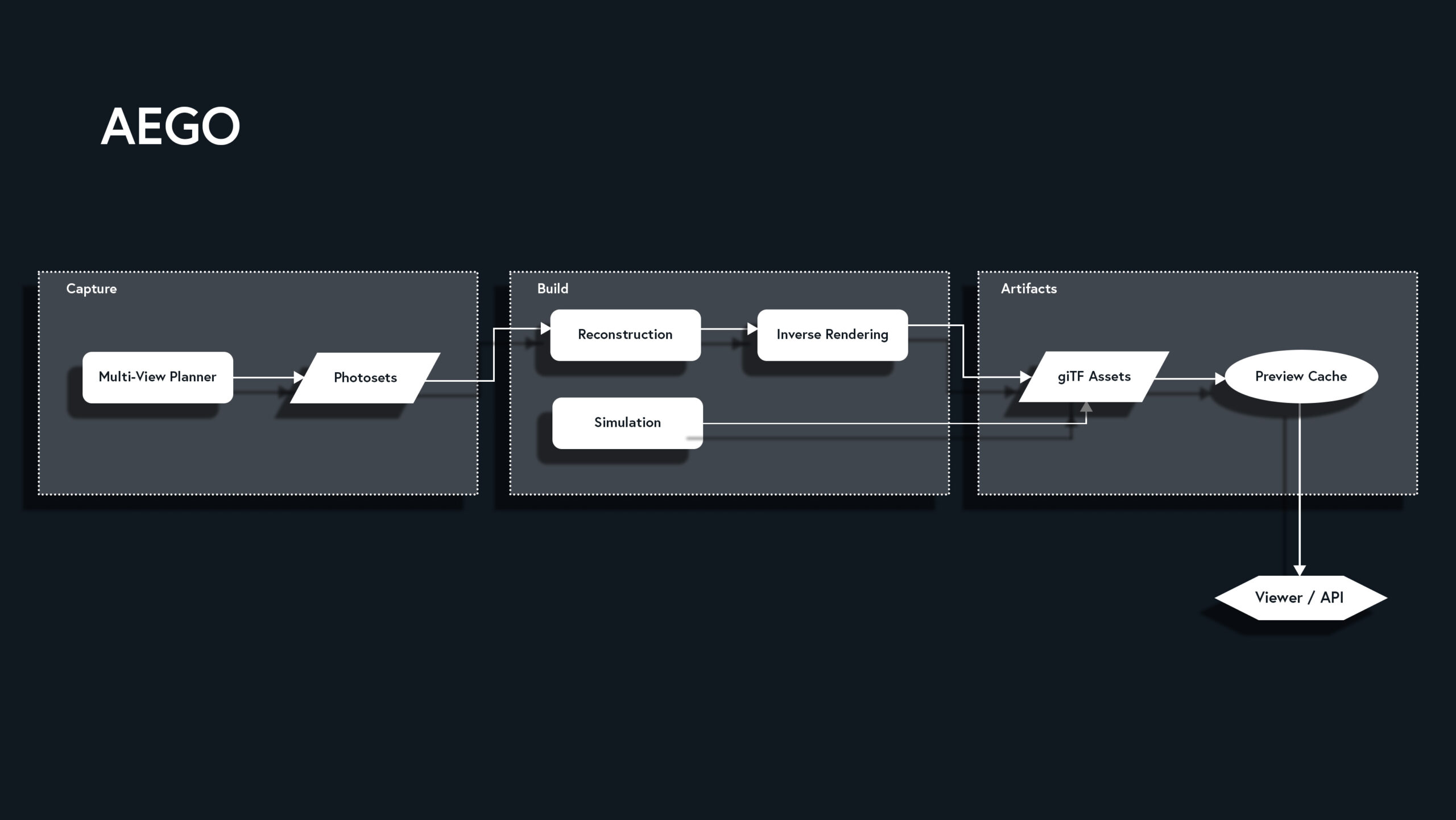
Multi-view Capture Orchestration
The process begins with structured acquisition. Aego guides structured AI 3D reconstruction from photos, directing capture strategies such as angles, baselines, and lighting variation, while calibrating optical parameters (intrinsics/extrinsics) to guarantee dataset consistency and reconstruction readiness. This structured approach is also the foundation for synthetic dataset generation for machine learning pipelines requiring annotated, condition-rich 3D inputs.
Neural Reconstruction & Inverse Rendering
By combining principles of photogrammetry with neural inverse rendering software, Aego estimates both geometry and material properties with scientific accuracy. Depth, reflectance, and surface normals are refined for realism and measurement, enabling defect detection digital twin workflows and surface fidelity analysis. GPU acceleration ensures speed without compromising rigor.
Visual datasets used during reconstruction can also be explored and compared through visual search AI with Iris, supporting similarity analysis and visual anomaly detection across large image collections.
Packaging & Delivery
Completed models are delivered as compact, interoperable glTF assets, enriched with condition layers and paired with lightweight viewers and APIs. This ensures reconstructed objects can be seamlessly inspected, compared over time, or integrated into AR/WebXR workflows.
Key Features
Condition-Enriched Digital Twins
Aego produces 3D assets in glTF enriched with measurable metadata, such as depth, normals, defect masks, ensuring not only visual fidelity but actionable diagnostic value for inspection, monitoring, and comparative analysis.
Evidence-Preserving Optimization
Advanced decimation and tiling strategies reduce file size for efficient rendering and distribution while safeguarding critical evidence. Fine textures, micro-defects, and diagnostic details remain intact, even in optimized outputs.
Immersive Deployment Across AR/WebXR
A lightweight SDK and direct export pipelines enable seamless integration into AR and WebXR environments. From immersive education to e-commerce engagement, reconstructed assets can be deployed interactively across platforms.
GPU-Accelerated Batch Pipelines
End-to-end GPU acceleration supports automated batch processing of large collections. Reconstruction, rendering, and denoising are parallelized at scale, enabling institutions to transition from individual objects to entire archives without loss of speed or fidelity.
Aego Applications
Inspection & Predictive Maintenance
Aego’s condition-aware 3D twins provide organizations with durable, measurable records of asset health. By embedding surface normals, depth, and defect layers, even subtle signs of wear or deformation become trackable over time. Instead of relying on periodic, manual inspections, organizations gain persistent, measurable digital records that evolve alongside the physical object. This enables predictive workflows where maintenance can be scheduled before failures occur, reducing downtime, extending asset life, and optimizing resource use across sectors such as aerospace, energy, and heavy industry.
Immersive Commerce & Marketing
For commercial applications, Aego elevates 3D asset production to production-grade fidelity while keeping assets lightweight enough for seamless distribution. Objects reconstructed from ordinary photosets are transformed into interactive digital experiences that can be embedded into websites, mobile apps, or immersive AR and WebXR platforms. These assets allow customers to explore products with photorealistic accuracy, rotating, zooming, or simulating material variations in real time. The result is faster time-to-market, lower costs, and more engaging product experiences that drive conversion and brand differentiation.
Conservation & Restoration
In heritage and museum settings, Aego’s 3D asset reconstruction for heritage conservation creates diagnostic twins enriched with condition metadata, offering conservators and institutions powerful tools for analysis, documentation, and intervention planning. Conservators can simulate “what-if” scenarios, testing potential restoration materials under virtual lighting, exploring how surfaces will react to aging, or documenting the state of fragile artifacts before and after intervention. Beyond restoration, Aego provides a permanent digital record of cultural assets, ensuring that their condition-aware digital twin remains preserved for study, replication, or public dissemination.
Condition-aware models can also be connected to visual data governance with Atlas to preserve reconstruction history, provenance, and changes to cultural assets across time.
Synthetic Data Generation for Machine Learning
Aego is uniquely positioned to accelerate AI development by producing synthetic datasets with scientifically controlled variations. By altering lighting conditions, injecting synthetic defects, or simulating material aging, Recon generates labeled datasets that mirror real-world conditions with far greater diversity than traditional data collection allows. These datasets provide a scalable, cost-effective alternative where annotated real-world data is limited or impractical, supporting the training and validation of machine learning systems for inspection, defect detection, and predictive modeling.
These reconstructed datasets can also support research and reproducible experimentation through visual data science with Cultura.
Aego Results
Aego consistently achieves high performance in 3D reconstruction benchmarks, balancing visual fidelity with computational efficiency. Reprojection error serves as the primary measure of geometric accuracy, confirming the alignment between reconstructed models and their source photo datasets. Image-based metrics such as PSNR and SSIM validate the realism of rendered outputs against original captures, ensuring that models retain both detail and structural integrity.
At the same time, Recon optimizes asset size relative to fidelity, applying adaptive decimation and tiling strategies that reduce file weight while preserving diagnostic evidence such as surface defects or fine textures. This balance enables reconstructed models to remain portable for AR/WebXR deployment and scalable for enterprise workflows, without compromising on analytical or visual quality.
Inquire About Aego
Frequently Asked Questions
What kind of hardware or camera setup does Aego require?
Aego is designed for AI 3D reconstruction from photos taken with standard cameras, including industrial inspection cameras, smartphones, and professional DSLRs. No specialist scanning hardware is required. The system guides structured capture strategies, including angles, baselines, and lighting variation, to guarantee reconstruction readiness from existing equipment.
How is Aego different from general-purpose 3D scanning tools like Matterport or Polycam?
Aego is photogrammetry digital twin software built for condition intelligence, not room capture. Unlike consumer 3D scanning tools, Aego embeds condition metadata including depth, surface normals, and defect masks directly into the output asset. The result is a condition-aware 3D digital twin that supports inspection, defect detection, and predictive maintenance, not just visualization.
What file formats does Aego output and can they be deployed in AR or WebXR environments?
Aego delivers completed models as compact, interoperable glTF assets ready for AR and WebXR deployment. These glTF digital twin files are enriched with condition layers and paired with lightweight viewers and APIs, ensuring reconstructed objects can be seamlessly inspected, compared over time, or integrated into existing operational and AR workflows.
Can Aego models be used to generate training data for AI systems?
Yes. Aego supports synthetic dataset generation for machine learning pipelines by producing annotated, condition-rich 3D assets that can serve as training inputs for defect detection, segmentation, and visual inspection models. This reduces the cost and time of manual data collection for teams building AI systems that require labeled, real-world-accurate visual data.
Is Aego suitable for heritage conservation and museum digitization projects?
Yes. Aego’s 3D asset reconstruction for heritage conservation is used by institutions to create diagnostic twins of artworks, artifacts, and architectural elements enriched with condition metadata. These twins support documentation, analysis, and intervention planning for conservators, offering a durable, measurable record that persists across decades of stewardship.